
lesson 2
WAY OF THINKING
Many people mistakenly believe that drawing is about what we do with our hands. Of course, the lines we draw and our hands are important, but that’s not where the magic happens.
Drawing is about what happens between our ears 🙂 It’s all about how your mind processes the world around you and how you communicate or transform this ‘understanding’ onto a horizontal surface. So it all makes sense when we start training our brains to understand the world as our eyes actually see it.
A drawing in school or in a group is told by the teacher to draw what you see!
This seems simple if you know what to look at. But if you don’t understand what you’re looking at, how can you draw it?
What happens is that our left brain tells us what the object is that we’re looking at. We try to recall the learned process of what a certain object looks like and in the end what we draw doesn’t even resemble it. We have no idea why the object looks different in our drawing.
Ez egyszerűnek tűnik, ha tudod mit kell nézni. De ha nem érted mit nézz, akkor hogyan tudnád lerajzolni?
Ami történik az, hogy a bal agyféltekénk elmondja, hogy mi az a tárgy amit figyelünk. Mi meg megpróbáljuk előhívni azt a tanult eljárást, hogy az a bizonyos tárgy hogy néz ki és végül amit rajzolunk nem is hasonlít. Fogalmunk sincs miért néz ki másként a tárgy a rajzunkon.
Then comes “I CAN’T DRAW” or “I WISH I COULD DRAW”.
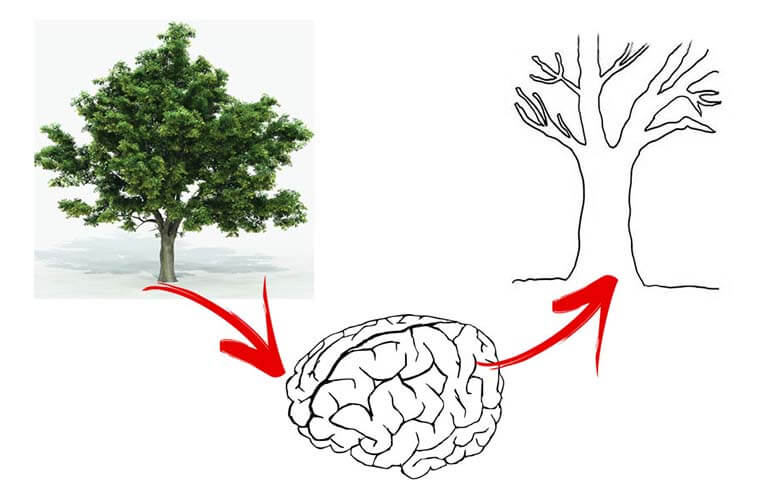
The problem is that our left brain, the analytical one, is in our way. The left brain is amazing, we couldn’t do math without it. We need to learn to intercept the information coming in through our eyes before it reaches the left brain. That way we can understand exactly what we are seeing.
Let’s see the world as a collection of abstract lines, shapes, colors, textures, and light and shadow values.
When our brain processes this, it doesn’t make any sense. Our left brain finds it boring and doesn’t bother with it anymore. When we draw, we use these things to create the illusion. We arrange the lines, shapes, colors, tones, textures on a flat surface. That’s what drawing what you see means!
Draw with your right brain

We start the first day by ‘training’ our minds to see space as abstract shapes. To do this, we need to bypass our left hemisphere so that it doesn’t get lost.
In Betty Edwards’ book Right-Brain Drawing, the most popular task is to draw the picture upside down. When we do this, it’s as if the left hemisphere is short-circuiting, shutting down its analyzing function because it doesn’t recognize the figure and therefore finds the task meaningless. This way, we can better pay attention to the lines and shapes, which results in us being able to successfully copy what we observe.
I have created a series of exercises that aim to develop attention by excluding the left hemisphere. Since these are abstract compositions, the mind doesn’t try to understand them and instead we are able to simply copy the lines and figures we see.
Do each task in order!
summary:
Task 1 – Find its counterpart
Task 2 – Copy the doodle
Task 3 – Practice observing objects and drawing them in your head.
Task 4 – Figure supplementary tasks, draw the exact mirror images
Task 5 – Now draw the exact mirror image without the help of a grid. Just pay attention to the lines, where they start and where they end. If it bothers you that the object is recognizable, turn the drawing over.
Task 6 – Copy the line drawing, enlarged or reduced.
Task 7 – Now try to redraw this complicated drawing, you can also turn it upside down.
Task 8 – Get to know the following online program! With this, you can divide any image into the number of squares you specify, which helps you draw
https://artisthu.com/grid-drawing-tool/
book recommendation:
I recommend Betty Edwards’ book, it’s full of exercises.